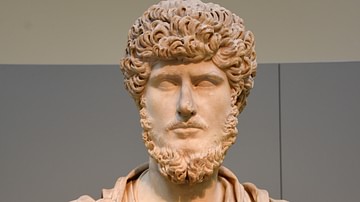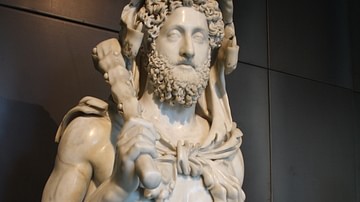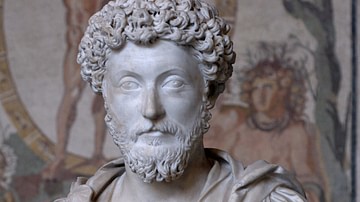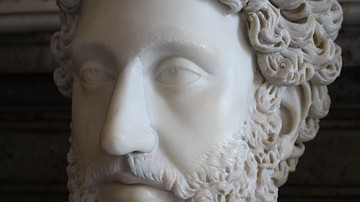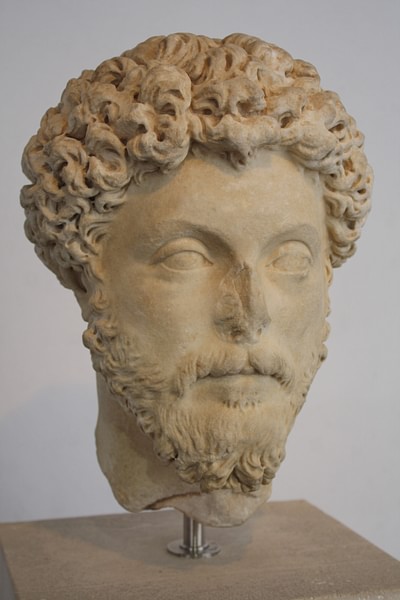
Marcus Aurelius (r. 161 to 180 CE) was a Roman emperor best known as the last of the Five Good Emperors of Rome (following Nerva, Trajan, Hadrian, and Antoninus Pius) and as the author of the philosophical work Meditations. Although it has been claimed he instigated a persecution of Christians, modern scholarship argues against this.
He has long been respected as embodying the Platonic concept of the Philosopher King as articulated in Plato's Republic: a ruler who does not seek power for his own sake but to help his people. He was introduced to philosophy at a young age and his Meditations, composed while on campaign in his fifties, make clear that he held a deeply philosophical, specifically Stoic, view throughout his life.
His reign, in fact, is defined by the Stoic view and he is referred to as “the philosopher” by the later historian Cassius Dio (l. c. 155-235 CE) and by the author (or authors) of the Historia Augusta (4th century CE), a history of Roman emperors. His Stoic outlook is expressed throughout his Meditations and his view of one's responsibility to others is made clear in a line from Book VIII.59: “People exist for the sake of one another; teach them, then, or bear with them.”
He lived his philosophy in both his private and public life in that he consistently placed the needs of the people before his own desires or visions of glory and worked for the common good. It is among history's ironies, however, that his reign is characterized by incessant warfare and the alleged persecution of the new religious sect of Christianity. Even so, he successfully conducted campaigns in Germania and managed the affairs of the empire efficiently. He died of natural causes following an illness in 180 CE and was instantly deified.
In the modern-day, he is probably best known from the popular film Gladiator (2000) as the father of Commodus (r.177-192 CE) whose decision to pass over his son as successor serves as the point of departure for the film's plot. Contrary to his depiction in the film, Aurelius was not killed by Commodus and, in fact, Commodus would co-rule with his father from 177-180 CE and succeeded him without opposition; though he would prove to be one of the worst rulers Rome would have to endure and his reputation suffered further by comparison with his father.
Early Youth
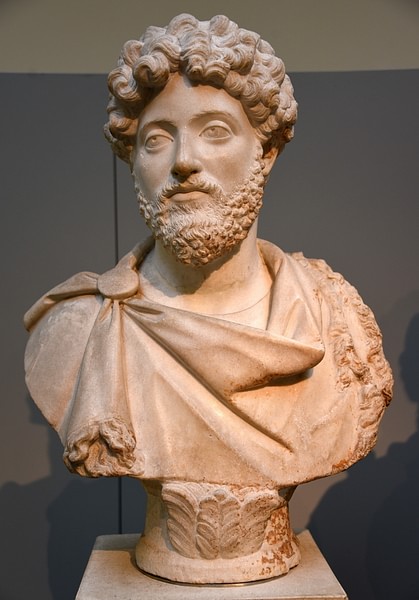
Marcus Aurelius was born in Spain on 26 April 121 CE to an aristocratic patrician family. His birth name was Marcus Annius Verus, after his father of the same name. His grandfather and great-grandfather on his father's side were senators and his mother, Domitia Lucilla (known as the minor, l. c. 155-161 CE), also came from a wealthy and politically connected family. Aurelius' father died in c. 124 CE and he was raised primarily by nurses and his grandfathers.
Events from his early life are suggested by comments he makes in his Meditations (especially in Book I), from correspondence between himself and his teacher Fronto, and from the Historia Augusta which, though often considered unreliable, is still cited by scholars when certain passages seem probable. Details of his younger years, therefore, are scarce but it is assumed he would have been brought up in accordance with traditional patrician practices, learned Greek at the same time he was learning Latin, and would have been groomed for a public life in rhetoric and oratory.
When he was in his early teens, around 132 CE, a teacher named Diognetus introduced him to philosophical texts. These were most likely works of the Cynic Philosophers who sought to live in the simplest way and disregarded all social conventions as artifice. Aurelius seems to have been quite impressed with this outlook as he then affected a typically Cynic lifestyle of dressing in a rough woolen cloak and sleeping on the ground or the floor of his room instead of his bed. He mentions this in Meditations Book I.6 in referencing how he chose “the Greek lifestyle – the camp-bed and the cloak” after his association with Diognetus.
He most likely would have also adopted the Cynic approach to simple, coarse food, few possessions, and neglect of basic hygiene. Although it is unclear, it seems that his mother forced him to stop his philosophical pursuits and focus on what she saw as a more respectable career path.
Sometime after this, he received new tutors in oratory and rhetoric and among these were Herodes Atticus (l. 101-177 CE) and Marcus Cornelius Fronto (d. late 160's CE) whose reputations for excellence in their arts were highly respected and commanded a high price. Fronto and Aurelius would become life-long friends and both he and Atticus would exert significant influence over the young Aurelius. He was shortly after betrothed to Ceionia Fabia, daughter of the respected politician Lucius Ceionius Commodus (d. 138 CE) and sister of Aurelius' future co-emperor Lucius Verus (r. 161-169 CE).
Adoption by Antoninus & Rise to Power
In 136 CE, the emperor Hadrian (r. 117-138 CE) selected Lucius Ceionius Commodus as his successor for reasons which are unclear. Commodus was married to Marcus Aurelius' aunt Faustina and it is probable that Hadrian chose Commodus as a kind of place-holder for the teen-age Aurelius who would then succeed him later. Commodus died in 138 CE, however, and Hadrian then chose Aurelius Antoninius (later known as Anoninus Pius (r. 138-161 CE) as successor with one stipulation: he had to adopt Marcus and Lucius Verus as his sons and successors. Antoninus agreed and young Marcus took the name Marcus Aurelius Antoninus and was groomed as the next emperor.
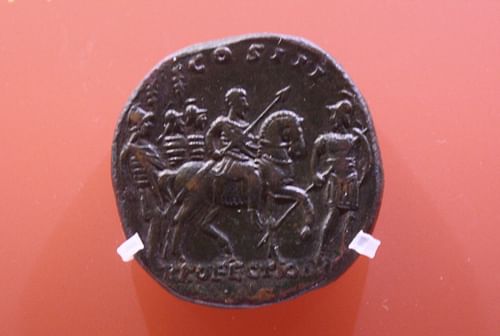
Antoninus Pius was an extremely effective monarch and an important role model for his successor. Aurelius devotes a long passage of praise to his adopted father in his Meditations in which he lists the emperor's impressive qualities (Book I.16). Antoninus had Aurelius' betrothal to Ceionia Fabia annulled and arranged a marriage between him and Antoninus' daughter Anna Galeria Faustina (known as Faustina Minor or Faustina the Younger, l. c. 130-175 CE).
Antoninus groomed his successor in almost every aspect of becoming an efficient ruler (though he neglected to instruct him in military matters) and, although Aurelius complied, his tastes ran more toward philosophical introspection than the mundane duties of court life. He lived where Antoninus instructed him to in order to further his reputation as one of the elite and also for practical purposes in fulfilling his responsibilities but it seems clear he would have preferred a simpler life elsewhere. He may have consoled himself at this time through philosophy – as he would do throughout his life – and later writes:
The things you think about determine the quality of your mind. Your soul takes on the color of your thoughts. Color it with a run of thoughts like these: Anywhere you can lead your life, you can lead a good one. Lives are led at court – so then good ones can be. (Meditations V.16)
In his letters to Fronto he complains about his tutors at the time and his duties, which were essentially secretarial, as well as court life in general. His philosophical bent would have made such duties seem fairly meaningless. Scholar Irwin Edman comments on this:
At the age of eleven, Aurelius dedicated himself to religion, for philosophy all his life was with him a kind of religion, the true inward religion that lay behind the rites and ceremonies of the imperial religion which he was careful and content to observe. He studied law and he studied arms. He had the education of an imperial gentleman, but of a gentleman who felt something missing in the outward show and in the outer world and felt ultimately that peace, if not happiness (which was impossible) lay in oneself. (Edman, Long, 5)
At about this time he was introduced to two new teachers who were brought to court by Antoninus to tutor Aurelius in philosophy. These were Apollonius of Chalcedon (dates unknown) and Quintus Junius Rusticus (l. c. 100-170 CE), one of the greatest Stoic philosophers of his day. In his Meditations, Aurelius praises both men highly and lists the many important lessons he learned from them.
In writing on Rusticus he thanks him “for introducing me to Epictetus' lectures – and loaning me his own copy” (I.7) and, regarding Apollonius, says he learned, “independence and unvarying reliability, and to pay attention to nothing, no matter how fleetingly, except the logos” (I.8). Both entries have to do with Stoic philosophical principles and strongly suggest that it was not until this time that Aurelius became acquainted with the Stoic outlook.
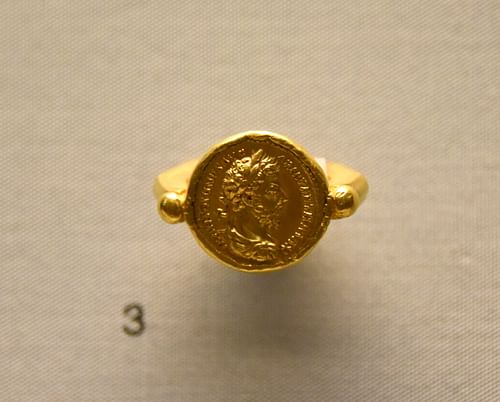
Epictetus (l. c. 50-130 CE) was the author of the Discourses and Enchiridion, famous lectures on Stoic principles and practice and the logos was the binding force in the universe which caused all things to be and kept all running harmoniously. If one concentrated one's focus on the logos, the Stoics claimed, one could live peacefully because one would realize that everything which happens is natural; it is only one's interpretation of an event which makes it “good” or “bad”.
Although Fronto strongly objects to Aurelius' interest in Stoicism in his letters, his former student embraced the philosophy fully and would put the principles he learned from his teachers into effect once he came to power.
Aurelius the Emperor
In March of 161 CE, Antoninus Pius died and the senate looked to Aurelius as the new emperor; in keeping with Hadrian's original designs, however, Aurelius refused the honor unless Lucius Verus was elevated as co-emperor with him. His request was granted and Aurelius and Verus began their reign by instituting programs to help the poor and rewarding the military with more pay and greater honor. They encouraged free speech, the arts, education, and boosted the economy – at least for a time – by debasing the currency; the two emperors quickly became immensely popular with the people.
Aurelius continued to hold fast to his Stoic principles as emperor but Verus, who had always been more extravagant, indulged himself through lavish parties and expensive gifts to friends. The Historia Augusta records one such “especially notorious” party at which Verus gave out “gold, silver, and gemmed bowls…golden vases in the shape of perfume boxes…carriages with silver harnesses” as well as many more luxuriant gifts and the entry concludes, “the cost of this dinner party has been estimated as six million sestertii [around $60 million]. When Marcus heard about this party he is said to have groaned and wept for the fate of the world” (Harvey, 280).
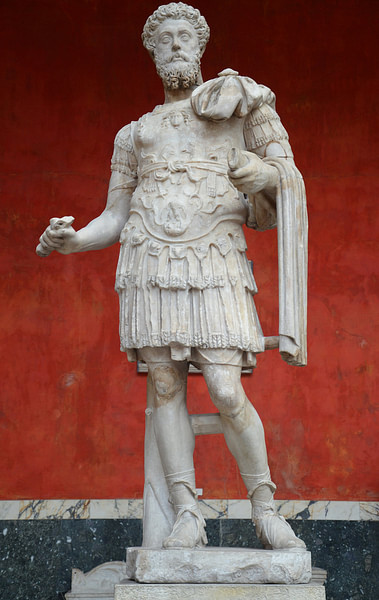
In late 161 CE, the Parthian king Vologases IV (r. 147-191 CE) invaded Armenia, which was under Rome's protection, and the Roman province of Syria revolted. Verus had more military experience than Aurelius and so took charge of the campaigns in the east personally. It is also thought that Aurelius may have manipulated Verus into going to curtail his extravagant parties. The Parthian Wars would last until 166 CE and concluded with a Roman victory. This success was due not so much to Verus but to the general Gaius Avidius Cassius (l. 130-175 CE) who brilliantly deployed the troops and devised the tactics.
While Verus was away on campaign, Aurelius remained at Rome and, by all accounts, performed his duties with distinction. He adjudicated court cases, reviewed and passed laws which benefited all the classes of Rome, and dealt with the various requests and difficulties that came in from the provinces. It is also during this time (c.162-c.166 CE, though they continued after) that he is alleged to have persecuted the new sect of Christianity which refused to honor the state religion and disrupted the social order.
Although it is clear that Christians were persecuted during Aurelius' reign, modern-day scholars increasingly claim that he did not decree them. Antoninus Pius had issued edicts protecting the Christians and so, it seems, did Aurelius. The persecution of Christians seems to have been orchestrated by regional governors, as suggested by the Apology for Christianity by Melito of Sardis (d. 180 CE) which he sent to Aurelius, asking him to intervene. It is possible Aurelius never received the work or, at least, there is no record of a response and regional persecutions continued through at least 180 CE.
By 166 CE, it looked as though the war with Parthia would be won. Aurelius had married Faustina in 145 CE and they had a number of children over the years. Even though some of these died young, Aurelius still had every reason to believe the gods could be smiling upon him with good fortune.
As the Parthian war concluded, however, the Marcomanni tribe of Germania invaded Roman provinces on the Danube in an alliance with the Persian Sarmatians. In 167 CE, Aurelius joined Verus in the field to drive back these invasions and restore order. It is possible, even likely, that Aurelius was advised in his campaign by the experienced military leader and consul Marcus Nonius Macrinus (d. c. 171 CE), whose early career and close relationship with Aurelius inspired aspects of the character of Maximus Decimus Meridius in the film Gladiator.
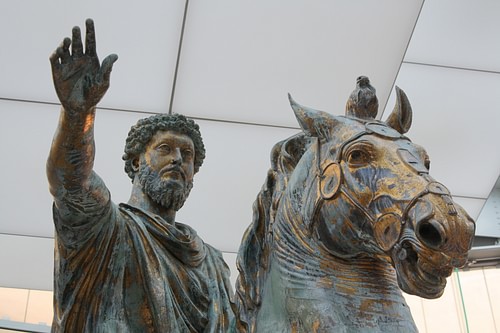
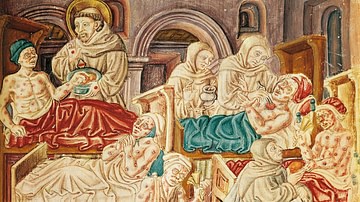
In 169 CE, Verus died – most likely of the plague his troops had brought back to Rome from campaign – and Aurelius ruled alone. He would devote most of his remaining reign to campaigns in Germania where he would write his Meditations.
The Meditations
Aurelius' Meditations is his true legacy to the world, far out-stripping any achievements of his reign, however notable they may have been. The work is a private journal of the emperor's thoughts written to encourage himself in living the best life possible. Scholar Gregory Hays comments:
The questions that the Meditations tries to answer are primarily metaphysical and ethical ones: Why are we here? How should we live our lives? How can we ensure that we do what is right? How can we protect ourselves against the stresses and pressures of daily life? How should we deal with pain and misfortune? How can we live with the knowledge that someday we will no longer exist? (xxiv-xxv)
The Meditations is far from a philosophical treatise, however; it is one man's thoughts on life and the struggle to remain at peace with one's self in a world which constantly threatens such peace. Aurelius' answer to the problem is not an answer but a course of discipline in denying one's self the luxury of self-pity. In accordance with the Stoic view, everything that happens in life is natural – sickness/health, satisfaction/disappointment, joy/sadness, even death – and it is only one's interpretation of events which can trouble a person. The logos, which controls all things, controls one's fate as well but, even so, a human being still has the freedom to choose how to respond to circumstance. Hays elaborates:
According to this theory, man is like a dog tied to a moving wagon. If the dog refuses to run along with the wagon he will be dragged by it, yet the choice remains his: to run or be dragged. (xix)
The universe, to Aurelius and the Stoics, is good and only has the best intentions for humanity; it is an individual's choice to interpret those intentions correctly and find peace or to choose to cling to one's impressions and suffer. Aurelius writes:
If it is good to you, O Universe, it is good to me. Your harmony is mine. Whatever time you choose is the right time. Not late, not early. What the turn of your seasons brings me falls like ripe fruit. All things are born from you, exist in you, return to you. (IV.23)
Although he would lose children, friends, and even his wife, Aurelius remained faithful to this vision of a world governed by a natural, and benign, intelligence which ran through all things, bound all things together, and dispersed all things in time. There was, then, no concept of tragedy in Aurelius' philosophy because everything that happened was a natural occurrence and nothing in nature could be interpreted as tragic. He writes:
Fear of death is fear of what we may experience: nothing at all or something quite new. But if we experience nothing, we can experience nothing bad. And if our experience changes, then our existence changes with it – change, but not cease. (IV.58)
Death & Legacy
Between 170-180 CE, Marcus Aurelius campaigned against the Germanic tribes and toured the eastern provinces of his empire. In 175 CE, his general Cassius rebelled in Syria, proclaiming himself emperor, before he was assassinated by a subordinate. Faustina accompanied Aurelius on campaigns 170-175 CE and went with him to Syria, Egypt, and Greece. She died in the winter of 175 CE.
In 178 CE, Aurelius defeated the Germanic tribes on the Danube and retired to winter quarters at Vindobona. He would die there two years later in March of 180 CE and was succeeded by Commodus. Although he had tried to groom his son in the same steady way that Antoninus Pius had him, he seems to have realized that he had failed. Commodus' self -indulgence and cruelty marked a reign which could not have been more different from his father's and proved true another of Aurelius' maxims from his Meditations IV.57: “What does not transmit light creates its own darkness.”
What happened to the Meditations after Aurelius' death is unknown but they somehow survived and copies were made and preserved. The text is mentioned in the 4th century CE by the orator Themistius (Hays, xliv) and in the Historia Augusta. No further mention of it is made until the 10th century CE when the cleric Arethas mentions copying it in a letter to a friend.
Arethas' copy may be responsible for preserving Meditations which is thought to have been among the books rescued from the library of Constantinople in 1453 CE when the city fell to the Ottoman Turks. These books were carried west where they were copied and, by 1559 CE, the first printed edition of the work was available. It has long since become a source of inspiration for people around the world who know Aurelius first as a philosopher and only second as an emperor; which is probably how Marcus Aurelius himself would have wanted it.